
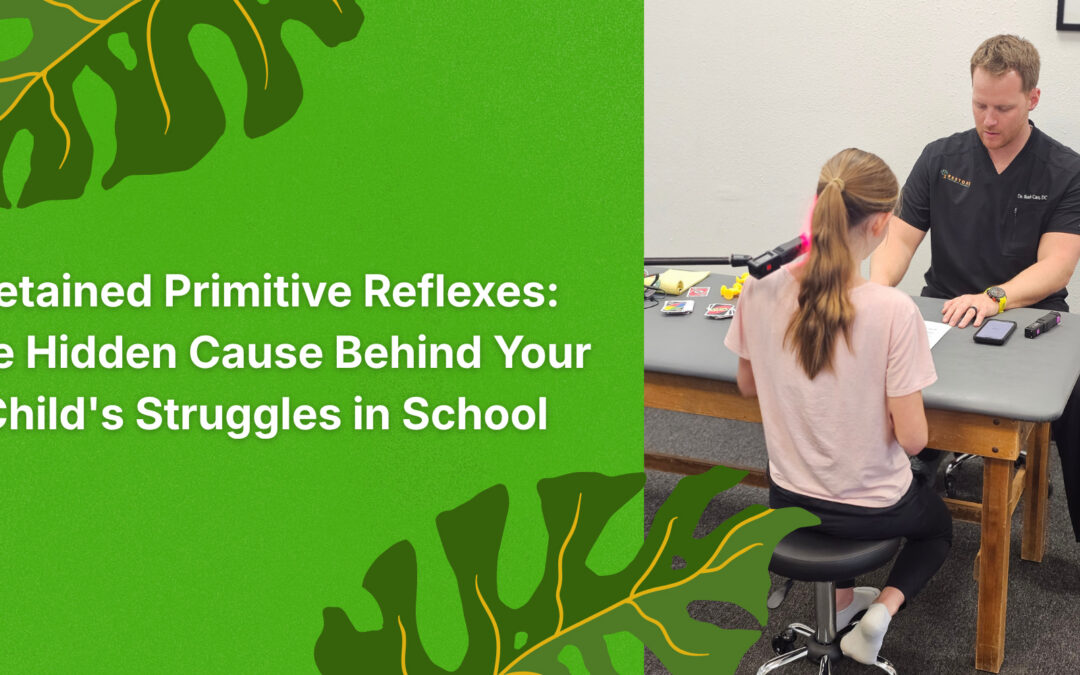
As another school year wraps up, many parents in the Joplin area are sitting down with report cards, teacher notes, and a quiet sense of worry. Maybe your child couldn’t sit still long enough to finish their math worksheet. Maybe their handwriting still looks like it did two grades ago. Maybe they came home in tears more days than not, frustrated that reading just doesn’t “click” the way it seems to for everyone else. If this sounds familiar, the issue may not be effort, attitude, or even attention. It could be something far more foundational: retained primitive reflexes.
What Are Primitive Reflexes?
Primitive reflexes are the involuntary movement patterns every baby is born with. They help newborns survive and develop, guiding everything from how they turn their head toward a sound to how they grasp a finger. As the higher centers of the brain mature during the first year or two of life, these reflexes are supposed to integrate, meaning they fade into the background so more sophisticated, voluntary movement and thought can take over.
When that integration doesn’t happen on schedule, those primitive reflexes stay active. And an active reflex in a six-year-old’s nervous system creates a constant undercurrent of noise, like trying to read a book while a radio plays static in the next room. The child isn’t being defiant or lazy. Their brain is working overtime just to filter out signals that should have been turned off years ago.
How Retained Reflexes Show Up in the Classroom
The connection between an immature reflex pattern and a struggling student is often invisible to teachers and even pediatricians, but the signs are everywhere once you know what to look for. A child with a retained Moro reflex may startle easily, struggle with emotional regulation, and seem perpetually on edge in a noisy classroom. A retained ATNR (Asymmetrical Tonic Neck Reflex) makes it difficult to cross the midline of the body, which directly affects handwriting, reading, and the ability to track a ball or a line of text from left to right.
A retained STNR can leave a child unable to sit upright at a desk for any length of time, leading to slouching, fidgeting, or the classic “W sit” on the floor. A retained Spinal Galant reflex can cause a child to wiggle constantly the moment the back of their chair touches their shirt. These aren’t behavior problems. They are neurological reflex problems that look like behavior problems, and no amount of discipline, sticker charts, or extra tutoring will resolve them at their source.
Why Summer Is the Ideal Window to Address Them
The end of the school year is often when parents finally have space to step back and ask, “What is really going on here?” Summer offers a rare stretch of time without homework deadlines, daily transitions, and the social pressure of the classroom. That makes it the ideal season to begin primitive reflex integration work. Children have the energy and bandwidth to engage fully in their exercises, and parents have the chance to build new routines without competing demands. By the time fall arrives, many families notice their child returning to school steadier, more focused, and more available for learning.
What Reflex Integration Looks Like at Restore Functional Neurology
At our Joplin office, Dr. Carr begins with a thorough evaluation to identify which specific reflexes are still active and how they are interfering with your child’s daily function. From there, we build a personalized plan that may include targeted movement exercises, chiropractic adjustments to support nervous system regulation, vestibular and balance work, eye-tracking activities, and other modalities depending on what your child needs. The goal is never to drill your child through generic exercises. It is to give the brain the specific input it missed earlier in development so it can finish the job it started.
Reflex integration isn’t a quick fix, but the changes families see often feel remarkable. Children who couldn’t sit through a meal start finishing their plates. Kids who hated reading start picking up books on their own. Handwriting tightens up. Meltdowns soften. And the child you always knew was in there gets a little more room to come forward.
Ready to Find Out What’s Really Going On?
If your child finished this school year carrying more struggle than they should have, summer is the time to look deeper. Reach out to Restore Functional Neurology in Joplin to schedule a consultation with Dr. Carr. We will help you understand what’s happening beneath the surface and map out a path forward that addresses the foundation, not just the symptoms.