
You have watched your child sound out the same word three times in a row. You have seen them lose their place halfway down a paragraph, complain that the words are “moving,” or push a book away after five minutes with tears in their eyes. The teacher has suggested more practice at home. The tutor has come and gone. Their vision test came back 20/20. And yet reading is still a battle. If any of that sounds familiar, the issue may not be intelligence, effort, or attention. It may be that your child’s eyes aren’t working together the way they should.
The Difference Between Seeing and Tracking
A standard vision screening measures visual acuity, which is essentially how clearly your child sees a letter on a chart across the room. What it does not measure is how well their eyes team up, move together, and track a line of text at close range. Those are separate skills, controlled by different systems in the brain, and a child can have perfect 20/20 vision while still having significant difficulty with the actual mechanics of reading.
Eye tracking is a broad term for the coordinated movements the eyes have to make constantly while reading. Saccades are the small, quick jumps from one word to the next. Smooth pursuits are the steady movements the eyes make when following a moving object. Convergence is the ability for both eyes to focus together on something close, like a page or a screen. When any of these skills are underdeveloped, reading requires enormous effort, and the brain gets exhausted long before the material does.
How Eye Tracking Problems Show Up
The signs are often mistaken for behavior or attention issues. A child with poor tracking may lose their place frequently, skip words or entire lines, re-read the same sentence without realizing it, or reverse letters and numbers well past the age when that should have resolved. They may hold the book unusually close, cover one eye, tilt their head, or rub their eyes constantly. Headaches after reading, avoiding reading altogether, and complaints of tired eyes or blurry words all point in the same direction.
Outside of reading, tracking issues can affect handwriting, copying from the board, catching a ball, riding a bike, and even navigating a crowded space without bumping into things. Kids who struggle here often get labeled as clumsy, inattentive, or unmotivated when the real story is that their visual system is fighting them from the moment they wake up.
Why This Isn’t Something Kids Just Grow Out Of
Eye tracking is a neurological skill, not just a muscular one. The eyes are controlled by intricate circuits in the brainstem and cerebellum that coordinate with the vestibular system, the visual cortex, and, importantly, the primitive reflex patterns a child was supposed to integrate as an infant. A retained ATNR reflex, for example, makes it neurologically difficult to move the eyes across the midline of the body, which is exactly what reading a line of text requires.
Without direct intervention, the underlying wiring doesn’t reorganize itself. Children learn to compensate. They memorize sight words instead of decoding. They avoid situations that expose the problem. They pour extra effort into every task and come home depleted. The compensation strategies can carry them through elementary school, but they often break down as the reading load increases in third or fourth grade and beyond.
What Eye Tracking Therapy Looks Like at Restore Functional Neurology
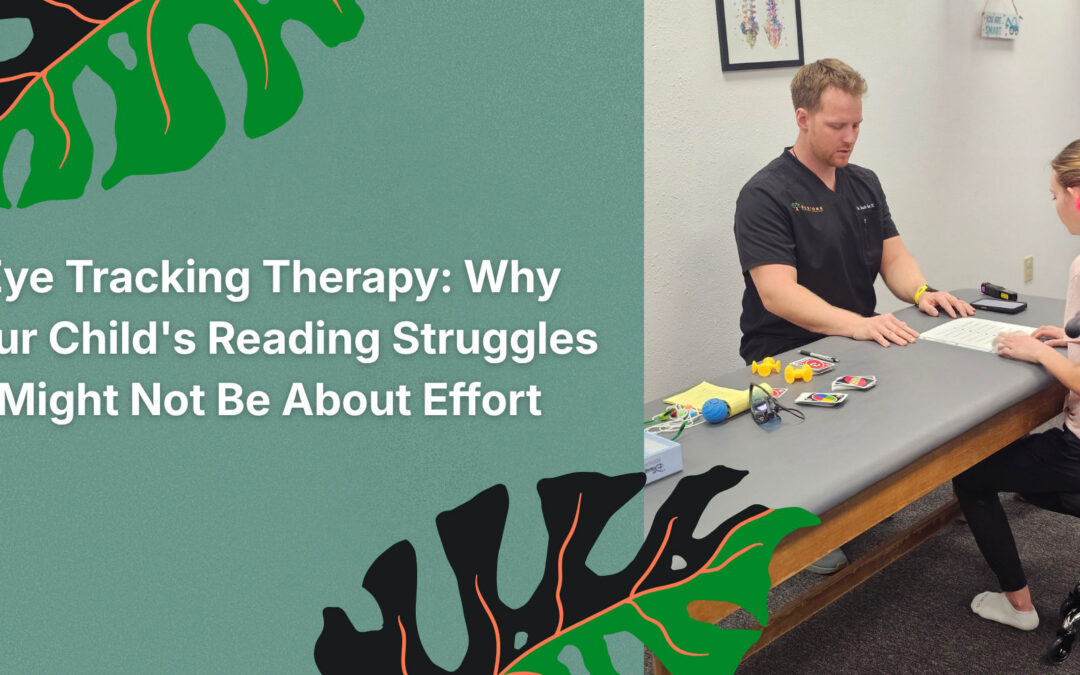
At our Joplin office, Dr. Carr begins with a functional neurological evaluation that looks specifically at how your child’s eyes move, team, and coordinate. From there, we build a plan that addresses the root of the issue, not just the symptom. That may include targeted eye movement exercises, primitive reflex integration work, chiropractic care to support the brainstem and cerebellum, vestibular activities to reconnect balance and visual systems, and home exercises that reinforce progress between visits.
The improvements families notice tend to show up gradually and then all at once. Homework battles shorten. A child starts choosing to read on their own. Handwriting tightens up. Sports and coordination become less frustrating. And the underlying confidence that took a hit from years of reading struggle starts to come back.
Summer Is the Right Time to Start
Summer offers something the school year rarely does: uninterrupted time to work on foundational skills without homework, testing pressure, or daily academic demands stacked on top. Starting eye tracking therapy now gives your child a genuine head start on fall, and it gives their nervous system space to make real changes before the reading load ramps back up.
If you have suspected for a while that something more than effort is at play in your child’s reading struggles, we would love to help you get to the bottom of it. Reach out to Restore Functional Neurology in Joplin to schedule a consultation with Dr. Carr. We will evaluate what is actually happening with your child’s visual system and map out a path forward from there.